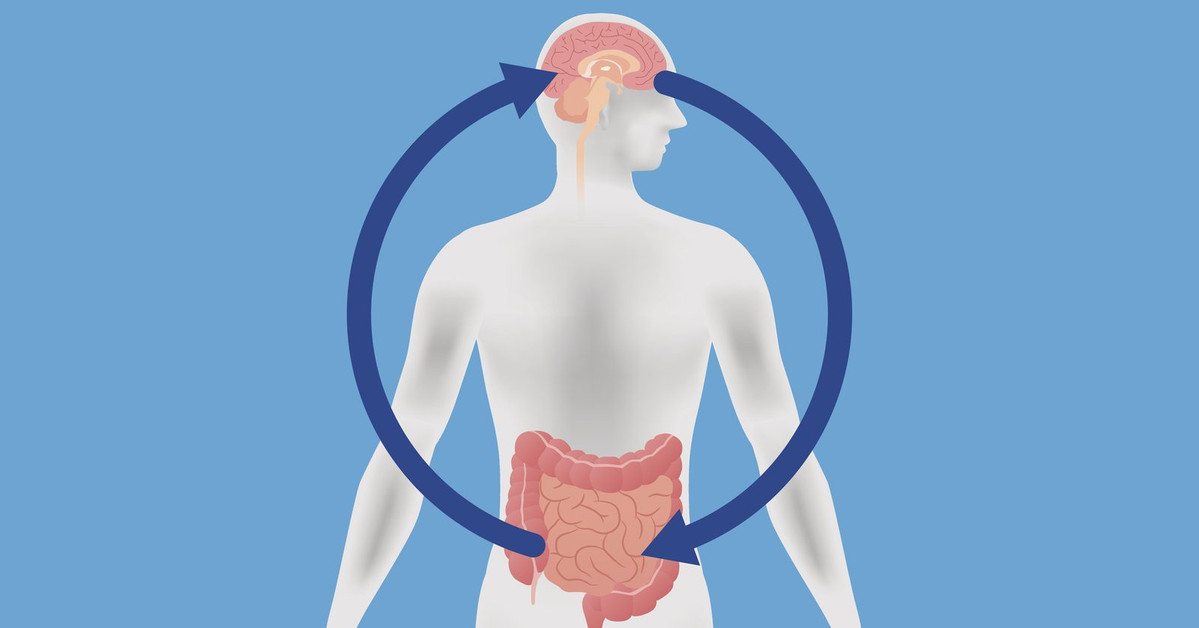
Your gut and your brain are in constant contact. Signals pass both ways through nerves, the immune system and substances made by the microbes living in your gut, a network scientists call the microbiota-gut-brain axis.1,2
There is a link with mood, but it is easy to overstate. Much of the clearest evidence comes from mice and rats, studies in people mostly show associations, and the trials of probiotics and diet in people are small.1,3
Key Takeaways
- Your gut and brain signal to each other through the vagus nerve, the immune system and substances made by gut bacteria. Much of the detail comes from animal studies.1,2
- More than 90% of the body's serotonin is made in the gut, but serotonin made in the gut does not cross into the brain.2,4,5 The brain makes its own.5
- In two large population studies of about 1,000 people each, people with depression or more depressive symptoms tended to have different gut bacteria. That is a link; it does not show that bacteria cause low mood.6,7
- Trials of probiotic supplements in people with depression or depressive symptoms are small and the results are mixed. A 2024 review of 12 trials found an effect on one rating scale but not on three others.3
- No food, probiotic or supplement replaces medical care. If low mood lasts more than two weeks, see a GP; if you have thoughts of harming yourself or need urgent help, use NHS 111, or call Samaritans on 116 123. If a life is at risk, call 999 or go to A&E.8,9
What is the gut-brain connection?
The gut-brain connection is the two-way traffic between your digestive system and your brain. A 2019 review of the field lists several routes: the vagus nerve, the immune system, the gut's own network of nerves, and substances made by gut microbes, such as short-chain fatty acids.1
The microbiota is the community of bacteria and other microbes living in your gut. The same review notes that many things shape it, including antibiotics, diet and stress, and that its diversity tends to fall as we age.1
Short-chain fatty acids are made by gut bacteria. They act on cells in the gut wall, on immune cells and on nerves, including the vagus nerve, which is one way the gut's microbes can pass messages on.2 The traffic also runs from the brain to the gut: stress can affect this whole system at every stage of life.1
For the wider picture of how stress and brain chemistry shape mood, see our guide to mood, stress and the brain.
How do gut bacteria send signals to the brain?
Gut bacteria seem to signal to the brain mostly indirectly, through substances that act on gut cells, immune cells and nerves. The vagus nerve, which links the gut to emotion-related networks in the brain, is one main route, though much of the evidence for it comes from studies in mice.2
Gut bacteria can make chemical messengers that the brain also uses, such as dopamine and GABA (gamma-aminobutyric acid, a messenger that damps down nerve activity). A 2021 review in Gastroenterology points out that these messengers are short-lived and do not pass easily into the brain, so a direct route is unlikely.2
The evidence for the nerve route comes mainly from animals. In mice, cutting the vagus nerve has been shown to block the effects of some Lactobacillus and Bifidobacterium bacteria on the brain.2 Whether the same happens in people is not yet known.2
Animal studies have also linked gut microbes to basic brain processes, such as the growth of new nerve cells and the building of myelin, the insulation around nerve fibres.1,2 The strongest evidence comes from germ-free mice, raised with no gut microbes at all.2 People always carry gut microbes, so these results do not carry over directly.
Is most of your serotonin really made in your gut?
Yes, but it stays outside your brain. More than 90% of the body's serotonin is made in the gut, mostly by cells in the gut lining called enterochromaffin cells.2,4 Serotonin made in the gut does not cross the blood-brain barrier, the protective lining of the brain's blood vessels.5
Your brain makes its own serotonin, while gut serotonin does its main jobs in the body, such as helping to control how the gut moves.4,5
Gut serotonin may still matter for the brain in a roundabout way. Animal studies suggest it can signal to the brain through the vagus nerve, and a 2015 study in mice found that certain gut bacteria raise the amount of serotonin the gut makes.4,5 What has not been shown is that changing gut serotonin changes mood in people.
You will often see the gut described as the source of your "happy chemical". It does make most of the body's serotonin, but the serotonin your brain uses is made in the brain itself.
What do studies in people show about gut bacteria and mood?
Large studies in people find that gut bacteria differ, on average, between people with and without depression. These are observational studies: they show a link at one point in time and cannot show whether bacteria affect mood, mood affects bacteria, or something else, such as diet or medicines, affects both.6,7
The Flemish Gut Flora Project in Belgium analysed stool samples from 1,054 people and checked its findings in a further 1,070 people from other studies.6 Two groups of bacteria, Coprococcus and Dialister, were less common in people with depression, even after allowing for the use of medicines for depression.6 The authors stressed how much other factors can confuse results like these.6
A 2022 Dutch study, by coincidence also of 1,054 people, drew on the Rotterdam Study. It linked 13 groups of bacteria with depressive symptoms, Coprococcus among them, and checked the findings in a further 1,539 people in Amsterdam.7 The most telling detail is that both studies, in two different countries, picked out Coprococcus. That makes the link more believable, but neither tested whether changing these bacteria would change your mood.
Faecal transplant research goes a step further. In a 2016 study, researchers collected gut bacteria from 34 people with depression and 33 without, then transferred samples from some of them into rats whose own gut bacteria had been depleted.10 Rats given bacteria from people with depression showed behaviour that researchers read as signs of low mood and anxiety in animals.10 In people, a faecal transplant means moving gut bacteria from a healthy donor's stool into someone else's gut. A 2021 review found that studies of these transplants in irritable bowel syndrome were limited, with mixed results and no clear overall benefit, and that good quality trials in people with depression were still to come at that time.2
Do probiotics help with low mood?
The evidence is mixed. A 2024 review of 12 trials with 707 people found that probiotics lowered scores on one common depression rating scale, but not on three others. (A rating scale is a set of questions, answered by the person or asked by a researcher, used to score mood.)3 The trials used many different bacterial strains, and the authors called for cautious interpretation.3
A 2023 review of 13 trials with 786 people with depression was more positive. Probiotic, prebiotic and synbiotic products, taken together, improved depressive symptoms more than placebo.11 (Prebiotics are fibres that gut bacteria feed on; synbiotics combine the two.) Split by type, only the products containing probiotics showed a clear effect, and the authors called for longer studies before any use in clinical practice.11
A recent pilot trial took place in London. Researchers gave 49 adults with depression, all taking medicine for depression that had not fully worked, either a multi-strain probiotic or a placebo for eight weeks.12 Depression and anxiety scores improved more in the probiotic group on some scales. But this was a pilot trial, part funded by a probiotic company, designed to test whether a full trial was workable rather than to prove an effect.12 So where does that leave you? On the evidence so far, a probiotic is not a reliable way to lift low mood, and it is no substitute for talking to your GP.
The NHS makes a point worth keeping in mind: a type of probiotic that helps with one problem may not help with others, and other types may not work as well.13 It also notes that probiotics are generally classed as food rather than medicine, so they do not go through the testing that medicines do.13
If you have an existing health condition or a weakened immune system, the NHS advises talking to a doctor before taking any probiotic supplement.13 If you take medicine for depression or any other prescribed medicine, do not stop it or change how you take it without talking to your doctor first.14
Can what you eat affect your mood through your gut?
Possibly, but it has not been shown directly. A 2017 Australian trial of dietary support in 67 adults with depression reported lower depression scores, but it did not measure gut bacteria, so it could not show whether any change came through the gut.15
That trial, called SMILES, compared seven sessions with a dietitian, built around a Mediterranean-style diet, with the same number of social support sessions over 12 weeks.15 Most people taking part were also having talking therapy, medicine or both.15 At the end, among those who completed the trial, 32.3% of the diet group and 8.0% of the social support group met the trial's definition of remission.15 The trial was small and single blind (the researchers scoring mood did not know which group people were in, but the participants did). Its authors noted that people knew they were in a diet study, which may have raised expectations.15
Two trials in healthy adults looked at the gut more closely. In an Irish study, 45 adults followed either a diet rich in fibre and fermented foods or a control diet for four weeks.16 Perceived stress fell by 32% in the diet group and by 17% in the control group, but the difference between the groups was not statistically significant, so it could have been down to chance.16
In a 2021 US trial, 36 healthy adults ate either a high-fibre diet or a diet high in fermented foods, such as yoghurt, kefir and fermented vegetables, for 10 weeks, as one phase of a longer study.17 In the fermented food group, the variety of gut bacteria rose and 19 of 93 markers of inflammation in the blood fell; the high-fibre diet did not change gut bacteria variety.17 The part worth noticing comes last: the team also measured stress and wellbeing, and found no significant change in either group.17
| Study | Who took part | What was tested | Main finding |
|---|---|---|---|
| Valles-Colomer and colleagues, 2019 (population study)6 | 1,054 adults in Belgium, checked in 1,070 more | Gut bacteria and depression at one point in time | Coprococcus and Dialister less common in depression; a link only |
| Radjabzadeh and colleagues, 2022 (population study)7 | 1,054 adults in Rotterdam, checked in 1,539 in Amsterdam | Gut bacteria and depressive symptoms | 13 groups of bacteria linked with symptoms; a link only |
| Kelly and colleagues, 2016 (animal study)10 | 34 people with depression and 33 without; rats | Gut bacteria from people transferred to rats | Rats showed behaviour read as signs of low mood and anxiety; animal work |
| Zhang and colleagues, 2023 (review of 13 trials)11 | 786 people with depression | Probiotic, prebiotic or synbiotic products against placebo | Symptoms improved overall; clear only for products containing probiotics |
| Rahmannia and colleagues, 2024 (review of 12 trials)3 | 707 people | Probiotics against placebo | Lower scores on one rating scale, not on three others |
| Nikolova and colleagues, 2023 (pilot trial, London)12 | 49 adults already taking medicine for depression | Probiotic or placebo for 8 weeks | Larger improvement on some scales; a pilot only |
| Jacka and colleagues, 2017 (SMILES trial)15 | 67 adults with depression | Dietary support or social support for 12 weeks | 32.3% versus 8.0% in remission among those who completed; small, single blind; gut bacteria not measured |
| Berding and colleagues, 2023 (trial)16 | 45 healthy adults | Fibre and fermented food diet or control diet for 4 weeks | Stress fell more in the diet group, but the difference between the groups was not significant |
| Wastyk and colleagues, 2021 (trial)17 | 36 healthy adults | High-fibre or fermented food diet for 10 weeks | Fermented foods raised gut bacteria variety; no change in stress or wellbeing |
Sources: the studies cited above.3,6,7,10,11,12,15,16,17
So none of this shows that any single food will change your mood. Eating more fibre is still a reasonable aim for general health: government guidelines say adults should eat 30g of fibre a day, and most adults eat only about 20g.18 Our guide to brain nutrition and our breakdown of foods for brain health cover the wider diet picture, and our article on natural approaches to mood looks at exercise, sleep and mindfulness too.
When should you talk to a GP about low mood?
The NHS advises seeing a GP if you have had a low mood for more than two weeks, if you are struggling to cope, or if the things you are trying are not helping.8 Changing your diet or taking a probiotic is not a substitute for that conversation, and a GP can talk you through the options.
If you have thoughts of harming yourself, or need urgent help for your mental health, the NHS says to use 111 online or call 111 and choose the mental health option.9 You can call Samaritans on 116 123 if you need someone to talk to.8 If someone's life is at risk, or you do not feel you can keep yourself safe, call 999 or go to A&E.9
Adults in England can also refer themselves to an NHS talking therapies service without seeing a GP first; in Scotland, Wales and Northern Ireland, a GP can explain the local options.8 If you feel foggy and tired rather than low, our guide to brain fog covers other common causes.
Frequently Asked Questions
Is the gut-brain connection real?
Yes. The gut and brain signal to each other through the vagus nerve, the immune system and substances made by gut bacteria, and a 2019 review in Physiological Reviews maps these routes in detail.1 What is less certain is how much this matters for mood in people, because much of the evidence still comes from studies in animals.
Does the gut make serotonin for the brain?
No. More than 90% of the body's serotonin is made in the gut, but serotonin made there does not cross the blood-brain barrier, so it cannot top up the brain's supply.4,5 The brain makes its own serotonin. Gut serotonin works mainly in the body, for example in controlling how the gut moves.5
Do probiotics help with low mood?
The trials are small and the results are mixed. A 2024 review of 12 trials found an effect on one depression rating scale but not on three others.3 The NHS advises anyone with a health condition or a weakened immune system to talk to a doctor before taking probiotic supplements.13 Never stop prescribed medicine without your doctor.
Can changing your diet affect your mood through your gut?
It has not been shown. One diet trial in adults with depression reported lower depression scores, without measuring gut bacteria.15 In two trials in healthy adults, diets rich in fibre and fermented foods changed gut bacteria or markers of inflammation, but neither found a significant difference in stress or wellbeing.16,17 The NHS advises adults to aim for 30g of fibre a day, from foods like wholegrains, beans, vegetables and fruit.18
When should I see a GP about low mood?
The NHS advises seeing a GP if you have had a low mood for more than two weeks, are struggling to cope, or find that what you are trying is not helping.8 If you have thoughts of harming yourself or need urgent help, use 111 online or call 111 and choose the mental health option.9 Samaritans are on 116 123 if you need someone to talk to. If a life is at risk, call 999 or go to A&E.9
Where BrainSmart fits
BrainSmart does not make a product for gut health, and none of our products is a probiotic or a fibre supplement.
Related Reading
These guides cover the wider science of mood, food and the brain.
- Mood, Stress, and Your Brain: A Comprehensive Guide to Emotional Wellbeing
The pillar guide to mood and stress, of which this article is one part. - Natural Approaches to Mood Support: What the Evidence Says
Exercise, diet, mindfulness and other approaches, with the strength of the evidence for each. - Brain Nutrition: The Essential Guide to Feeding Your Mind
The nutrients the brain depends on, and what the research says about each. - The Best Foods for Brain Health: A Nutrient-by-Nutrient Breakdown
Where to find brain nutrients on your plate. - Brain Fog: Causes, Science, and Evidence-Based Solutions
The common causes of brain fog, from sleep to stress.
References
- Cryan JF, O'Riordan KJ, Cowan CSM, et al. The microbiota-gut-brain axis. Physiological Reviews. 2019;99(4):1877-2013. doi:10.1152/physrev.00018.2018
- Margolis KG, Cryan JF, Mayer EA. The microbiota-gut-brain axis: from motility to mood. Gastroenterology. 2021;160(5):1486-1501. doi:10.1053/j.gastro.2020.10.066
- Rahmannia M, Poudineh M, Mirzaei R, et al. Strain-specific effects of probiotics on depression and anxiety: a meta-analysis. Gut Pathogens. 2024;16(1):46. doi:10.1186/s13099-024-00634-8
- Yano JM, Yu K, Donaldson GP, et al. Indigenous bacteria from the gut microbiota regulate host serotonin biosynthesis. Cell. 2015;161(2):264-276. doi:10.1016/j.cell.2015.02.047
- Tang J, Krushelnycky L, Shaqo A, Cho CE. A comprehensive review of nutritional influences on the serotonergic system. Advances in Nutrition. 2025;16(11):100524. doi:10.1016/j.advnut.2025.100524
- Valles-Colomer M, Falony G, Darzi Y, et al. The neuroactive potential of the human gut microbiota in quality of life and depression. Nature Microbiology. 2019;4(4):623-632. doi:10.1038/s41564-018-0337-x
- Radjabzadeh D, Bosch JA, Uitterlinden AG, et al. Gut microbiome-wide association study of depressive symptoms. Nature Communications. 2022;13(1):7128. doi:10.1038/s41467-022-34502-3
- NHS. Low mood, sadness and depression. Page last reviewed 29 July 2026. Accessed 7 October 2026. https://www.nhs.uk/mental-health/feelings-symptoms-behaviours/feelings-and-symptoms/low-mood-sadness-depression/
- NHS. Where to get urgent help for mental health. Page last reviewed 26 April 2023. Accessed 7 October 2026. https://www.nhs.uk/nhs-services/mental-health-services/where-to-get-urgent-help-for-mental-health/
- Kelly JR, Borre Y, O'Brien C, et al. Transferring the blues: depression-associated gut microbiota induces neurobehavioural changes in the rat. Journal of Psychiatric Research. 2016;82:109-118. doi:10.1016/j.jpsychires.2016.07.019
- Zhang Q, Chen B, Zhang J, et al. Effect of prebiotics, probiotics, synbiotics on depression: results from a meta-analysis. BMC Psychiatry. 2023;23(1):477. doi:10.1186/s12888-023-04963-x
- Nikolova VL, Cleare AJ, Young AH, Stone JM. Acceptability, tolerability, and estimates of putative treatment effects of probiotics as adjunctive treatment in patients with depression: a randomized clinical trial. JAMA Psychiatry. 2023;80(8):842-847. doi:10.1001/jamapsychiatry.2023.1817
- NHS. Probiotics. Page last reviewed 24 November 2022. Accessed 7 October 2026. https://www.nhs.uk/conditions/probiotics/
- NHS. Antidepressants. Page last reviewed 12 June 2025. Accessed 7 October 2026. https://www.nhs.uk/medicines/antidepressants/
- Jacka FN, O'Neil A, Opie R, et al. A randomised controlled trial of dietary improvement for adults with major depression (the 'SMILES' trial). BMC Medicine. 2017;15(1):23. doi:10.1186/s12916-017-0791-y
- Berding K, Bastiaanssen TFS, Moloney GM, et al. Feed your microbes to deal with stress: a psychobiotic diet impacts microbial stability and perceived stress in a healthy adult population. Molecular Psychiatry. 2023;28(2):601-610. doi:10.1038/s41380-022-01817-y
- Wastyk HC, Fragiadakis GK, Perelman D, et al. Gut-microbiota-targeted diets modulate human immune status. Cell. 2021;184(16):4137-4153.e14. doi:10.1016/j.cell.2021.06.019
- NHS. How to get more fibre into your diet. Page last reviewed 2 March 2026. Accessed 7 October 2026. https://www.nhs.uk/live-well/eat-well/digestive-health/how-to-get-more-fibre-into-your-diet/

Tom Kaplan
Brain Health Writer at BrainSmart
Tom Kaplan is a brain health writer focused on cognitive health, brain nutrition, and evidence-based approaches to supporting mental performance across the lifespan. His work draws on peer-reviewed research across neuroscience, nutritional psychiatry, and cognitive psychology, translating complex clinical findings into clear, practical guidance that helps readers make informed decisions about their brain health. Read Full Bio →